
Neither type is universally better. The right choice depends on the sound source, room, application and the equipment in your signal chain.
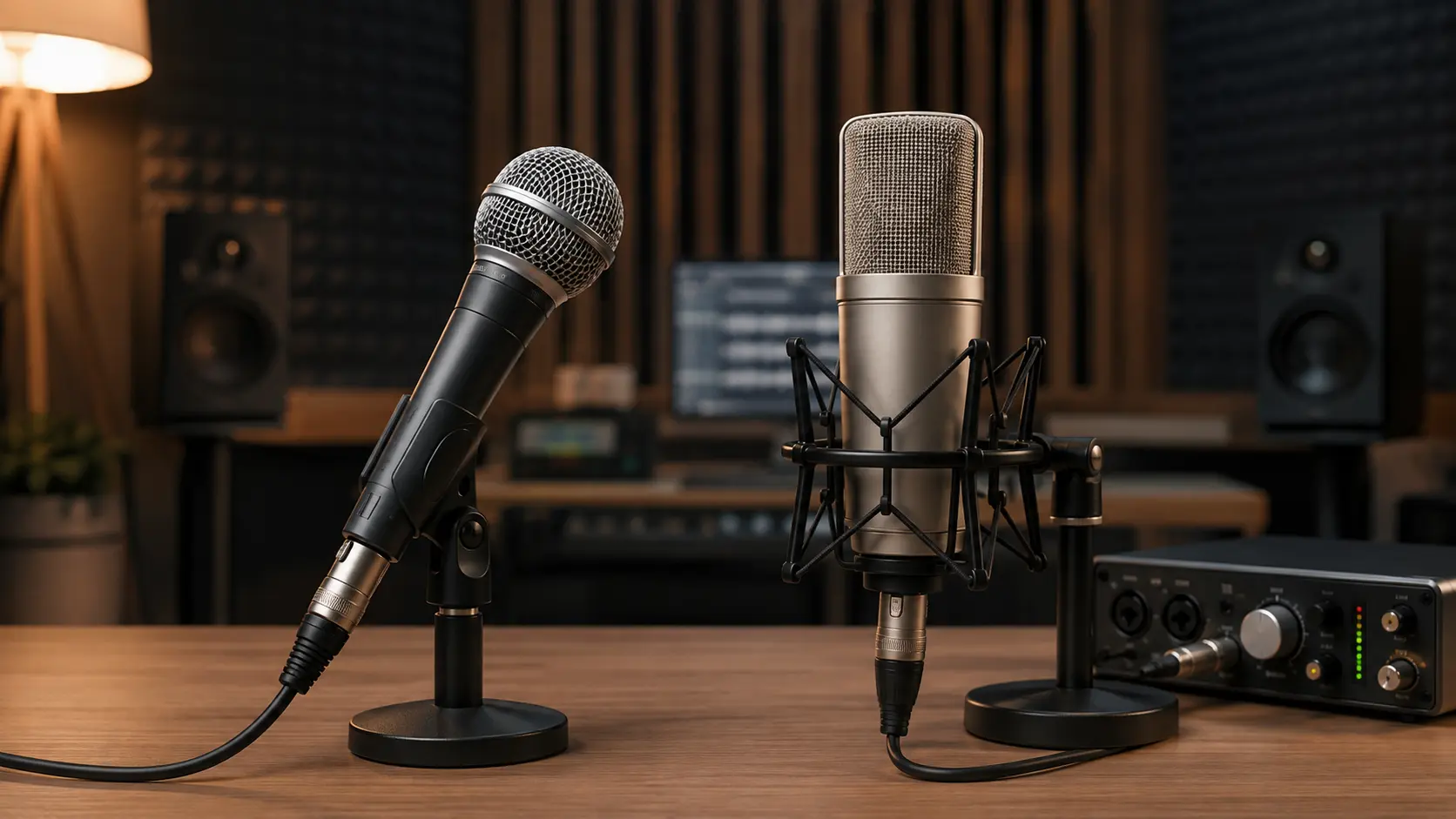
Quick Answer
Start with a dynamic microphone when close-miking, live use, a less-controlled room or a loud source is the priority. Start with a condenser when recording in a quiet, controlled environment and capturing fine detail is important. This is a starting rule, not an absolute: polar pattern, distance and the individual microphone can change the result.
Contents
- What Is a Dynamic Microphone?
- What Is a Condenser Microphone?
- Dynamic vs Condenser: Side-by-Side
- Five Factors That Matter Beyond the Label
- Which Microphone Should You Choose?
- Frequently Asked Questions
What Is a Dynamic Microphone?
In a moving-coil dynamic microphone, sound moves a diaphragm attached to a coil within a magnetic field, generating an electrical signal that represents the sound.
This design normally needs no power for the transducer itself, and conventional dynamics often have lower sensitivity than condensers. In practice they are commonly used close to the speaker or source, which can improve the ratio of direct sound to room sound.
That is why dynamics are common for live vocals, guitar amplifiers, drums and podcasting. But saying a dynamic 'doesn't pick up background noise' is misleading: any microphone can capture room sound when distance, gain, polar pattern or placement works against you.
- Common for close-miking and live applications.
- Some low-output models may require substantial interface/preamp gain.
- Do not assume every dynamic is cardioid; polar pattern is a separate property.
What Is a Condenser Microphone?
A condenser microphone uses a conductive diaphragm and backplate that form an electrical capacitor; diaphragm movement changes the capacitance to create a signal related to the sound.
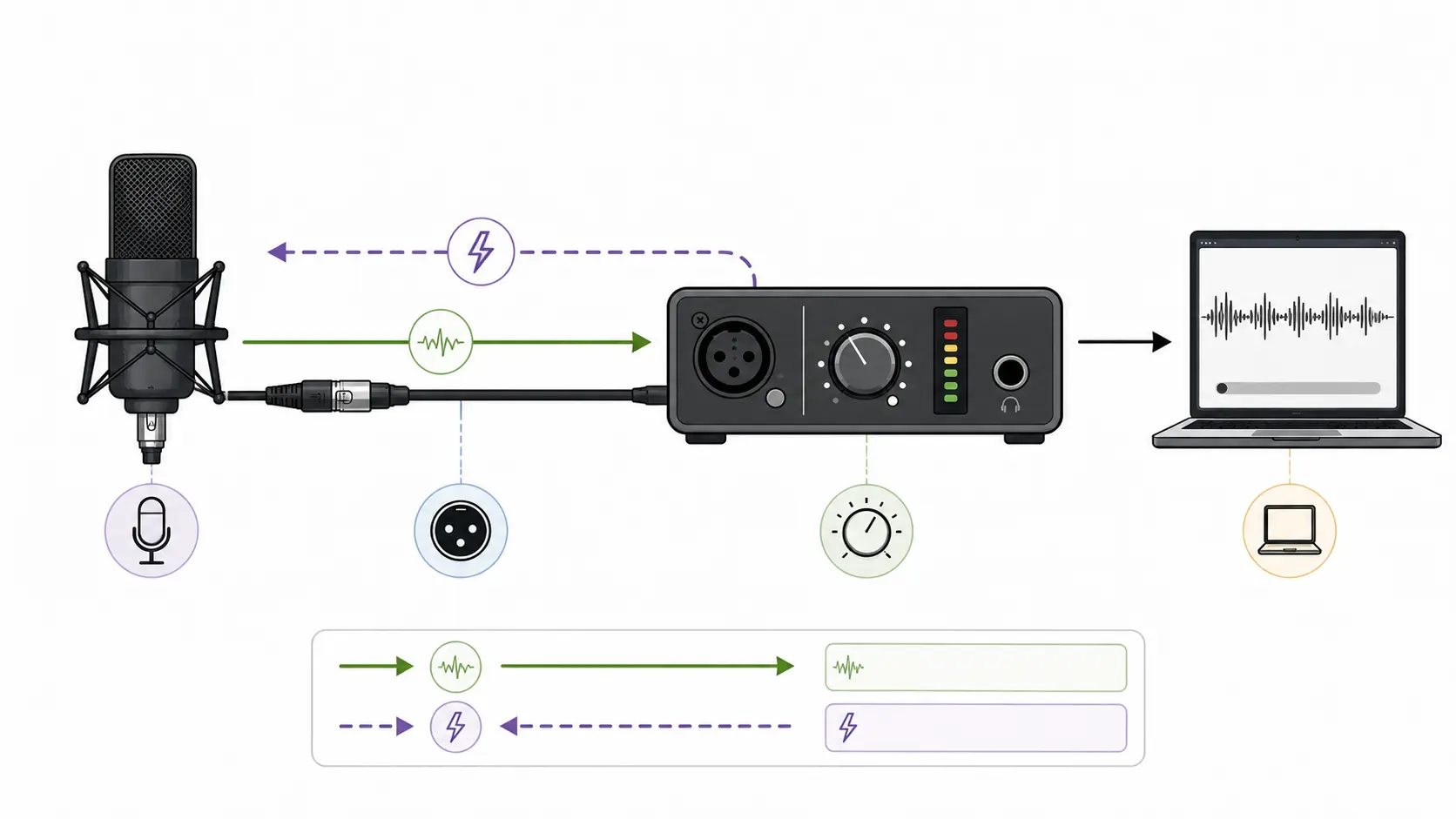
Condensers contain active electronics and therefore need power. Many professional XLR condensers use phantom power, commonly provided by a 48V control on an interface or mixer. Powering varies by design, however: some microphones use batteries or other supplies, while USB microphones receive power through their digital connection.
Condensers often offer higher sensitivity and response suited to fine detail, making them popular for vocals, acoustic instruments and studio recording. Higher sensitivity does not automatically mean higher quality, and a condenser is not necessarily unsuitable for loud sources; many condensers are designed for very high sound-pressure levels.
- Often well suited to fine detail and relatively quiet sources.
- Verify the actual power requirement of the model.
- Can be excellent on loud sources when the microphone's specifications allow it.
Dynamic vs Condenser: Side-by-Side
Sensitivity
- Dynamic: Often lower; commonly suited to close-miking.
- Condenser: Often higher; captures quieter signals more readily.
Detail & transient response
- Dynamic: May sound more focused with less emphasis on fine transients, depending on design.
- Condenser: Often responds well to fine detail and transients.
Loud sources
- Dynamic: Very common on loud sources; still check the model.
- Condenser: Not excluded; many condensers handle high SPL and some provide pads.
Room pickup
- Dynamic: Close placement can reduce the room's relative contribution.
- Condenser: May reveal more room sound when used farther away or at high sensitivity.
Power
- Dynamic: Passive balanced models normally need no phantom power; active designs are an exception.
- Condenser: Requires power; many XLR models use phantom power.
Gain
- Dynamic: Some models need substantial gain, especially on quiet speech.
- Condenser: Higher output often reduces required preamp gain.
Typical use
- Dynamic: Live, close podcasting, amps, drums, challenging rooms.
- Condenser: Studio, vocals, acoustic instruments, detailed capture.
Five Factors That Matter Beyond the Label
Room & distance
Moving closer can improve direct-to-room sound. Treatment and placement strongly affect the result.
Polar pattern
Cardioid, omni and figure-8 describe directional pickup; they are not synonyms for dynamic or condenser.
Preamp gain
Check microphone sensitivity and available clean interface gain, especially for low-output dynamics.
Power
If the microphone requires phantom power, make sure your interface or mixer provides it. Do not apply 48V blindly to unknown equipment.
Connection
USB versus XLR is separate from dynamic versus condenser. USB may integrate conversion and preamp stages; XLR relies on external equipment.
Signal Chain: Where Power and Gain Matter
Which Microphone Should You Choose?
Use this decision tree as a starting point, then verify the specifications of the model you plan to buy.
Is the room quiet and reasonably controlled?
- No: Next: Can you place the microphone close to the voice or source?
- Yes: Next: Is detailed capture of vocals or an acoustic source the priority?
Can you place the microphone close to the voice or source?
- Yes: Start with a dynamic suited to close-miking, with a polar pattern and placement that reject unwanted sound.
- No: Do not rely on transducer type alone; improve the room or placement and choose a pattern suited to the required distance.
Is detailed capture of vocals or an acoustic source the priority?
- Yes: A condenser is a logical starting point; verify power, SPL capability and polar pattern.
- No, live use or a loud source: A dynamic is common and practical, but a condenser designed for the source can also be appropriate.
Frequently Asked Questions
Is a condenser microphone better than a dynamic microphone?
No. Each serves different conditions. A condenser may suit detailed capture in a controlled room, while a dynamic can be more practical for close or live use. Model, placement and room matter more than declaring one technology superior.
Do dynamic microphones avoid background noise?
Not exactly. Any microphone can capture unwanted sound. Dynamics are often used close to the source, which improves the wanted-sound-to-room ratio. Pattern, distance and placement are crucial.
Does a condenser microphone need 48V phantom power?
Many XLR condensers use phantom power, but powering is design-specific. Some use batteries or dedicated supplies, while a USB microphone normally receives power through USB. Follow the model's specifications.
Will phantom power damage a dynamic microphone?
A passive dynamic with a correctly balanced XLR output is normally unaffected by properly applied phantom power. Do not generalize this to unbalanced or miswired equipment or ribbon microphones; check the manufacturer when uncertain.
Does a dynamic microphone need an inline gain booster?
Not always. It depends on microphone sensitivity, source level, distance and available clean preamp gain. Some low-output dynamics on quiet speech need substantial gain, but do not buy a booster before confirming your interface cannot provide enough.
Does USB mean the microphone is a condenser?
No. Connector/interface type and transducer technology are separate dimensions. USB microphones can use different transducer designs, while both dynamics and condensers can use XLR.
Key Takeaways
- There is no universal winner between dynamic and condenser microphones.
- For an untreated room and close speech, a dynamic is often a practical starting point.
- For detailed capture in a quiet, controlled room, a condenser is often a strong starting point.
- Polar pattern, distance and placement are separate from transducer type and can radically change the result.
- Check phantom power, gain and microphone sensitivity before buying.
- Do not assume condensers cannot handle high SPL or that dynamics cannot capture room sound.
Related Articles
Ready to Compare Your Options?
Once you know your use case, browse the microphone type that fits it, then compare polar pattern, sensitivity, power and gain requirements for each model.